
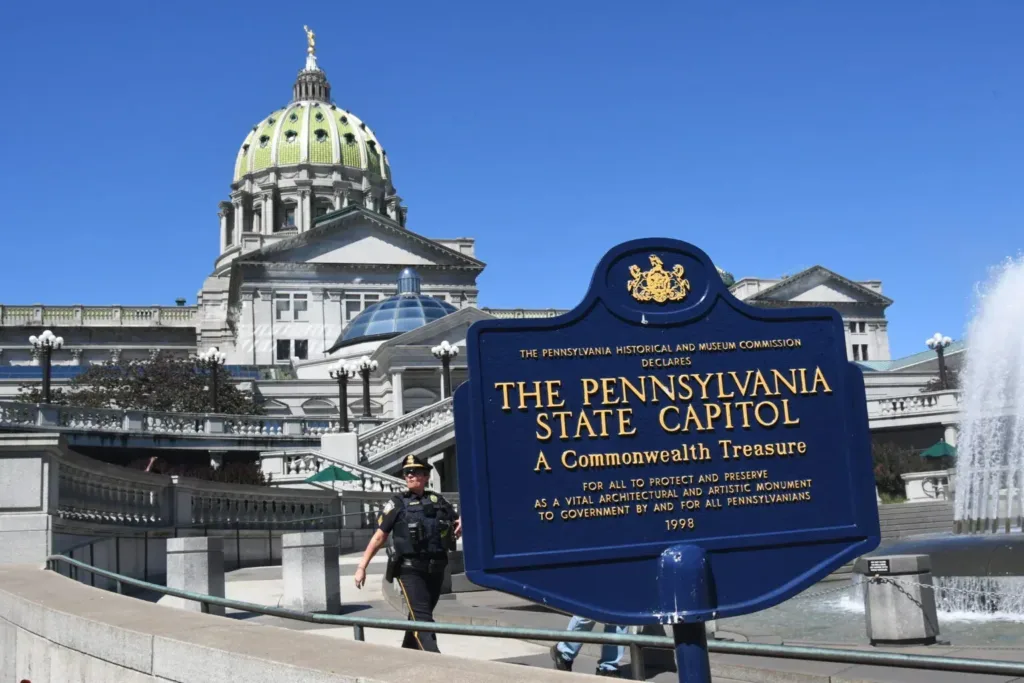

HARRISBURG – Democrats’ sweep of Pennsylvania government has turned a long-shot idea into a live one: rewriting the state constitution so lawmakers could tax people at different rates. But the path to doing it is slow. If they try a shortcut by statute, instead, they will run up against a state Supreme Court that has spent nearly a century saying no.
At issue is Article VIII, Section 1, the uniformity clause, which requires taxes to be uniform upon the same class of subjects. Sen. Tim Kearney, D-Delaware, filed a co-sponsorship memo in July titled “Creating a Fair Tax System: Uniformity Clause Repeal.” A House joint resolution, H.B. 2807, was referred to the Finance Committee after its introduction in late September.
Rep. Morgan Cephas, D-Philadelphia, said after the election at a public discussion hosted by the Pennsylvania Chamber of Business and Industry that repeal of the clause would be key to financing many of the Democrats’ new priorities now that they have won the so-called “trifecta” of power.
Broad + Liberty reached out to Sen. Kearney, Rep. Cephas, and Governor Shapiro for comment on this article. None provided a statement by deadline.
Changing the state constitution is a drawn out process by design. A proposal must pass both chambers, then pass again in the next legislature, then go to voters in a statewide referendum. If the first legislative vote comes in the 2027-28 session, the earliest ballot would be around 2029, after an intervening election that could change who controls the General Assembly.
Courts can also stop an amendment on process grounds. In Bergdoll v. Kane, the Pennsylvania Supreme Court declared a vote on a ballot question null and void because it bundled two amendments into one. A badly drafted question is a risk for the sponsors, separate from the politics.
Wording is another front. The Department of State, which answers to the governor, writes the ballot question for constitutional amendments. In 2021, Republican lawmakers accused the Wolf administration of writing the questions on emergency powers to encourage a no vote that would have left the governor’s broad powers intact — the outcome Wolf wanted. The administration defended the wording. Voters approved both amendments anyway over Wolf’s objections.
David Taylor, president and CEO of the Pennsylvania Manufacturers’ Association, opposes any change to the uniformity clause and said he expects the wording to be a problem if a repeal of the uniformity clause ever makes it to the ballot. “The uniformity clause is a very important institutional barrier to the growth of the state, which of course is why it’s being targeted now,” Taylor said. “I would expect that there would be another bad faith wording of the question on the ballot such that it would preclude the voters from making a reasoned consideration of the question and its effects. [The question] would probably be pretty much, ‘Do you want free money?’”
The alternative is changing rates by statute and leaving the clause alone. The Court’s record there is long.
In 1935, the Court held that a graduated income tax violated the uniformity provision. In 1971, in Amidon v. Kane, it held the state’s Personal Income Tax unconstitutional under the clause, and part of its reasoning was that the tax used the federal personal exemption, even though its rate was nominally flat. Pew Charitable Trusts has noted that the Court’s reading differs from 44 of the 47 other states with uniformity clauses, and that no income or wage levy in Pennsylvania may be graduated.
The Court has kept applying the clause strictly in recent years. In 2016, it declared a gaming tax with variable rates unconstitutional, in an opinion by Justice David Wecht. In 2017, it held that a cap on net-loss carryovers in the corporate tax violated the clause. In September 2025, it struck down Pittsburgh’s tax on nonresident athletes and performers for treating them differently from residents without proper justification.
The Court is not uniformly hostile to differing rates. In 1985, in Leonard v. Thornburgh, the Court found valid reasons for taxing Philadelphia resident wage earners at a higher rate than nonresidents and reversed a lower court ruling that had struck down the tax. The taxpayer carries the burden of showing a tax classification is unreasonable. And in 2024, the Court backed away from a taxpayer-friendly remedy, ruling that its decision invalidating the corporate loss cap applied only prospectively, which cost one company a refund.
Who sits on the Court matters. Voters in 2025 preserved Democrats’ 5-2 majority, though Justice Christine Donohue will reach the mandatory retirement age in 2027. Justices Donohue, Dougherty and Wecht, all Democrats, have signed on to decisions that applied the clause against the government.
Whether a statute that charges different rates on wages and on business or investment income would survive is an open question. Broad + Liberty found no Supreme Court ruling squarely on that kind of split.
Note to Readers: This story was reported entirely by Todd Shepherd. Drafts of this article were written with significant assistance from an AI writing tool. Shepherd reviewed, edited, and is responsible for all factual content.
Todd Shepherd is Broad + Liberty’s chief investigative reporter. Send him tips at tshepherd@broadandliberty.com, or use his encrypted email at shepherdreports@protonmail.com. @shepherdreports


